PACE4 : Fusion-Evaporation Code

(Back to home)
This is a subprogram that is found within the LISE++ software package that can be used for performing fusion-evaporation calculations.
A fusion-evaporation is a nuclear reaction that occurs when two ions fuse together and eject one or more particles immediately after the point of fusion.

The guide below shows how to perform a basic simulation using this software.
PACE4 User Guide
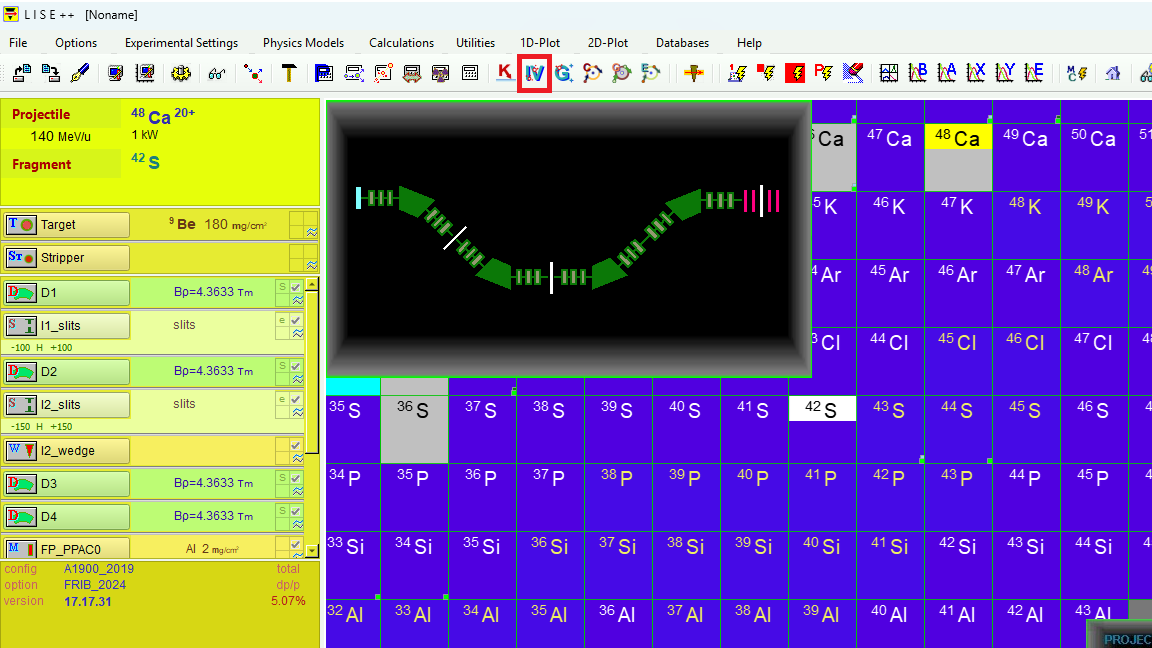
- The PACE4 program is opened via the LISE++ main interface (The button is shown in the red box):
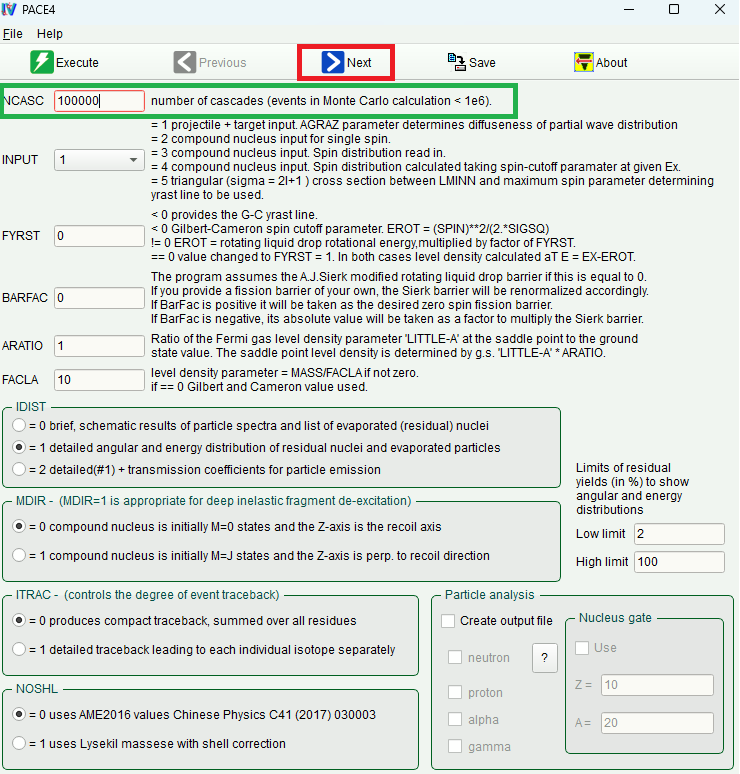
- The PACE4 menu will then load. For carrying out a simple calculation, many of the options on this page can be left as they are. However, the menu labeled
as 'NCASC' (shown in the green box) controls how many cascades the software will calculate for the ions that you select. The more cascades that are used, the better your results will be.
For this example, 100,000 cascades were used. The next page of the menu is accessed with the 'Next' button (shown in the red box).
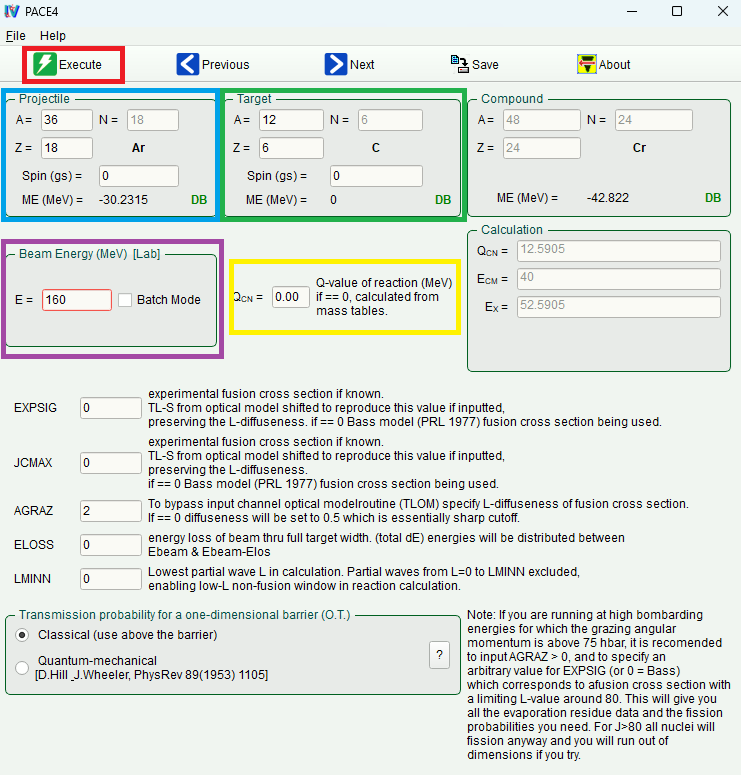
- This menu is where the projectile and target composition are specified, as well as the beam energy. The projectile information (shown in the blue box) is given in terms of its
mass number (A) and number of protons (Z). The target information (shown in the green box) is also given in terms of its mass number (A) and number of protons (Z). The energy at which the
projectile is sent towards the target with is specified by the beam energy (shown in the purple box). You may also specify a value for the Q-value of the reaction (shown in yellow box), but it can
be left blank, in which case the software will calculate it from its mass tables.
The calculation is started using the 'Execute' button (shown in the red box).
- When the calculation is complete, the program will display a document on your screen which shows the data that was generated. This includes a list of all ions that were produced, in terms of the numbers of
each that were produced, as well as the percentage of the total group that they make up and the cross-section for each of these ions.
Tables for the energy and angular distribution of each of these ions is also shown.
LISE++ is developed and maintained by the LISE++ Group at Michigan State University.
Reference: O. B. Tarasov and D. Bazin, Nucl. Instrum. Meth. B (2008) 4657–4664.
Official Website : lise.frib.msu.edu/lise
Disclaimer: The Physics Compendium links to third-party software and websites.
These are provided for convenience and reference only. No guarantee is made
regarding safety, accuracy, or availability of external content. Users are
responsible for verifying and securing any software they download.
This site is not affiliated with any software authors or institutions.